Reflex or Reason? Rethinking the Default Case for Asbestos Removal
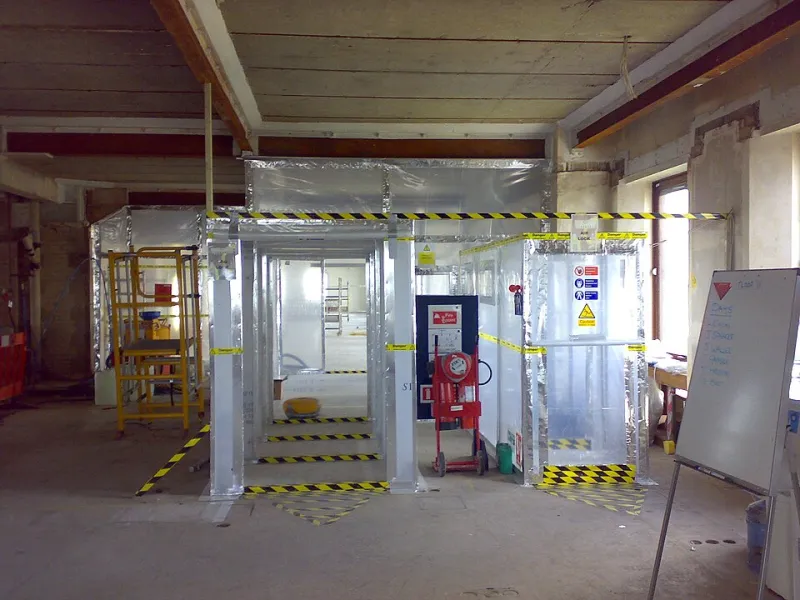
Photo: Fevs101, CC BY-SA 3.0, via Wikimedia Commons
Ask a room of property professionals what should happen to asbestos found in a commercial building and the answer will usually be the same: get it out. The instinct is understandable. Removal feels conclusive. It reads as diligence, and it is easy to defend to a board that wants the issue to disappear.
But the regulatory position is more measured than the instinct suggests. The Control of Asbestos Regulations 2012 require duty holders to manage the risk from asbestos-containing materials, not to eliminate the materials themselves. Where a material is in good condition, unlikely to be disturbed and properly recorded, in-place management is a legitimate and often preferable response. Removal is one option among several — and it carries its own hazards.
What removal actually involves
Removal of licensable material is a controlled demolition activity. It requires an enclosure, negative pressure, decontamination facilities, respirators and protective clothing, air monitoring and formal clearance before the space can be reoccupied. The process protects workers and occupants effectively, but it is not neutral: it consumes energy, generates contaminated waste that must travel to a licensed facility, and occupies the space for the duration.
There is also a simple point about risk transfer. The safest asbestos is the asbestos that is not being disturbed. Removing an intact material introduces a period during which fibre release is possible, however well controlled. That trade-off deserves to be explicit rather than assumed away.
The three credible options
In-place management
The material stays, but the duty holder operates a regime: an accurate register, labelling, periodic condition inspection, contractor communication, permit-to-work arrangements and a review cycle. This is proportionate for intact materials in low-disturbance locations and is the correct baseline for most of the UK's commercial stock.
It depends entirely on the quality of the regime. A register that has not been updated since the last fit-out, or a labelling scheme nobody on site recognises, is not management — it is documentation of good intentions. Where the management regime is weak, in-place management becomes harder to defend.
Enclosure or encapsulation
Sealing or enclosing a material reduces the likelihood of disturbance while leaving it in situ. It suits plant rooms, service voids and areas with limited access, and can be delivered with far less disruption than full removal. The trade-off is that the material remains on the register, remains subject to inspection, and may complicate future works.
Removal
Removal permanently resolves the liability for that material and simplifies every subsequent intervention in the space. It is the right answer in a defined set of circumstances — and the wrong one in others.
When removal genuinely is the right call
The case is strongest where one or more of the following applies:
- The material is damaged, friable or deteriorating, and containment is not practical.
- Disturbance is unavoidable, for example because of planned refurbishment or demolition.
- The space is due for a change of use that will bring occupants into regular contact.
- Condition cannot be monitored reliably because access is impractical.
- A contractual, lease or insurance requirement mandates removal.
- The management regime cannot realistically be sustained at the required standard in that location.
Notably, most of these are driven by condition, access or future works — not by the mere presence of asbestos.
When management deserves serious consideration
In-place management is often the more defensible choice where the material is intact, in a plant room or riser with restricted access, well recorded, and unlikely to be disturbed before a planned intervention. The long-term cost of a competent management regime is usually far lower than a removal programme, and the carbon and disruption savings are substantial.
That said, management is not a euphemism for deferral. It requires annual review, condition checks at defined intervals, and a genuine commitment to briefing contractors. A duty holder who chooses management must be able to demonstrate that the choice was reasoned and that the regime is functioning.
Documenting the decision
The quality of the decision matters less than the quality of the record. A short written rationale — what was found, what condition it was in, what options were considered, why the selected option was preferred, and when it will be reviewed — is worth more under scrutiny than any amount of retrospective justification.
Removal remains an entirely appropriate answer in many buildings. The point is that it should be an answer arrived at, not assumed. Duty holders who can explain why they chose management, enclosure or removal are in a far stronger position than those who simply chose the option that felt most decisive.