Rain, Rust and Reinforced Cement: Bringing External Asbestos Assets Under Control
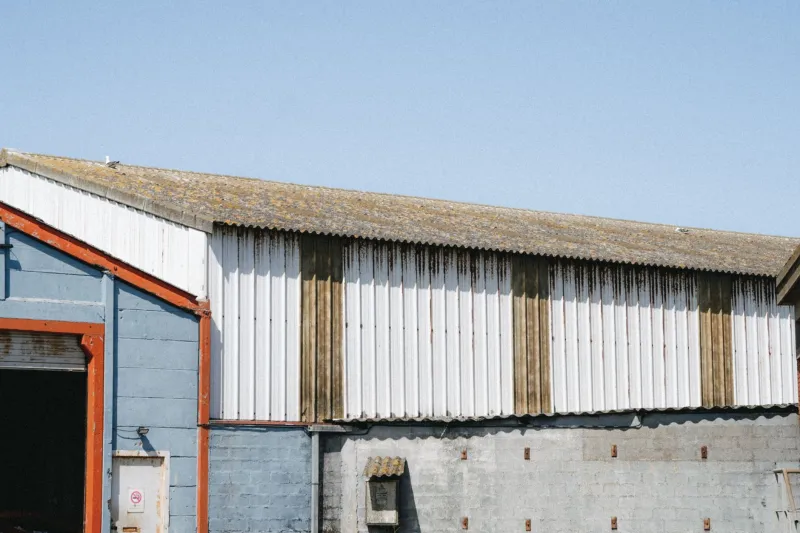
Few phrases do more damage to asbestos management in the UK than "it's only cement". The material is genuinely lower risk than a lagged pipe or an asbestos insulating board partition, and that fact is worth stating plainly. But low risk is not the same as no risk, and it is certainly not the same as no duty. On many commercial estates the asbestos cement roof, the gutter run and the downpipes represent the largest single concentration of asbestos-containing material on site — and the part of the estate most exposed to weather, to ladder work, to casual intervention and to storm events nobody planned for.
The purpose of this article is not to alarm. It is to argue that external asbestos cement deserves a defined place in the management plan, with its own inspection rhythm, its own contractor controls and its own decision logic.
Why the exterior falls off the register
Asbestos cement products — typically corrugated roof sheets, slates, rainwater goods, flue terminals and soffit panels — generally contain a modest proportion of chrysotile (and occasionally amosite in older stock) bound firmly in a cement matrix. When sound, the fibres are locked in place. The material will not release measurable airborne concentrations simply by existing.
The problem is behavioural rather than chemical. Because the roof is 'outside', it is often excluded from the survey scope, omitted from the register, or noted once and never revisited. Maintenance teams then treat it as ordinary building fabric: a contractor walks the roof, a gutter is rodded through, a broken sheet is replaced with a like-for-like substitute of uncertain origin.
Under regulation 4 of the Control of Asbestos Regulations 2012, the duty to manage extends to all non-domestic premises and to the common parts of domestic premises — there is no carve-out for external surfaces. If the material is present and liable to be disturbed, it belongs in the plan.
How weathering changes the picture
Age is the principal driver. Decades of freeze–thaw cycling, UV exposure and biological growth break down the cement matrix. What begins as a sound sheet can become friable at the surface, and a roof that sheds grit into the gutter is a roof that is releasing fibres. Moss and lichen hold moisture against the surface and accelerate the process.
Three activities convert that slow deterioration into a foreseeable incident:
- Pressure washing and aggressive cleaning. A high-pressure jet directed at weathered cement can liberate fibres and spread contaminated run-off across the site.
- Gutter clearance. Rodding, scooping and vacuuming a gutter lined with degraded cement debris is a routine task that very often generates dust, and it is frequently commissioned without any reference to the register.
- Repair and partial replacement. Drilling, cutting or breaking out sheets produces dust and debris; snapping fixings releases material at the point of disturbance.
Storm damage belongs in the same analysis. A dislodged sheet in a car park, or a fractured downpipe discharging across a walkway, creates an immediate need for a decision — and an immediate opportunity to get it wrong under time pressure.
A proportionate inspection regime
Inspection frequency should follow condition and consequence, not a single site-wide rule. A reasonable baseline for most commercial estates is an annual visual inspection of external cement assets, increased to six-monthly where the material is visibly aged, where there is heavy vegetation, or where the roof is regularly accessed for other plant maintenance. Post-storm inspections should be triggered by defined criteria — wind speed thresholds, reports of damage, or visible debris.
Inspections should be carried out by someone competent to recognise deterioration in asbestos cement: cracking, delamination, surface erosion, failed fixings, ponding, blocked outlets, corrosion at gutter brackets and joints. The output should be a dated record with photographs, condition grading and any recommended action, filed alongside the asbestos register rather than in a separate building fabric folder. Where access requires roof work at height, the inspection should be planned as a work-at-height activity in its own right, with the same controls that would apply to any other contractor.
Controlling the contractors who actually touch it
Most fibre release from external cement happens in the hands of a contractor who was never told the material was there. The register is only useful if it reaches the people commissioning the work.
Practical measures include: issuing a site-specific asbestos briefing at induction that names the external cement assets; adding a permit condition requiring written confirmation that the contractor has seen the register; prohibiting pressure washing of cement roofs and gutters without a written assessment; and requiring any works that will cut, break or abrade cement to be referred back to the duty holder before starting. Where disturbance is unavoidable, a task-specific risk assessment and method statement should set out the controls — often simple, but always documented.
Cement work is generally non-licensed, but notifiable non-licensed work may apply depending on the material, its condition and the task, and the notification, medical surveillance and record-keeping requirements that follow must be observed where they apply.
Repair or remove: a defensible decision
There is no default answer, and both extremes are unwise. Blanket removal of sound cement roofing is expensive, disruptive and carries its own fibre-release risk; indefinite patching of a failing roof defers cost while accumulating hazard.
A workable decision framework weighs four factors:
- Condition. Localised damage on otherwise sound sheets can often be repaired with proprietary systems and encapsulation coatings, provided the repair is compatible and documented.
- Access and exposure. A roof over a plant room with frequent access presents a different risk profile from a roof over an unoccupied yard.
- Lifecycle. Where the roof is nearing end of life on its own merits, removal during a planned refurbishment is usually the more rational route than piecemeal intervention.
- Regulatory trajectory. Where a building is scheduled for change of use, major refurbishment or demolition, a refurbishment or demolition survey will be required, and early removal may simplify the programme.
Whatever the decision, record the reasoning. A defensible file explains why the chosen course was proportionate, not merely what was done.
Waste, from skip to consignment
Asbestos cement waste is hazardous waste. It must go to a suitably permitted facility, be carried by a registered waste carrier, and be accompanied by the correct documentation. Where the waste is produced by a contractor, confirm in writing who holds the duty of care and verify the consignment notes against the quantities removed. Double-bagging of small fragments, wrapping or sheeting of sheets, and damping down are ordinary controls, but they depend on being specified in the method statement rather than improvised on the day.
The takeaway
External asbestos cement is not a background concern to be revisited at the next major project. It is a managed asset with a predictable failure curve, a small number of high-consequence activities, and a clear regulatory home. Give it a named place in the register, an inspection rhythm matched to its condition, and contractor controls that reach the people holding the ladder — and the risk stays where it belongs: bound in the cement, not drifting across the estate.