Beyond the Certificate: Making Asbestos Awareness Briefings Work on Live UK Sites
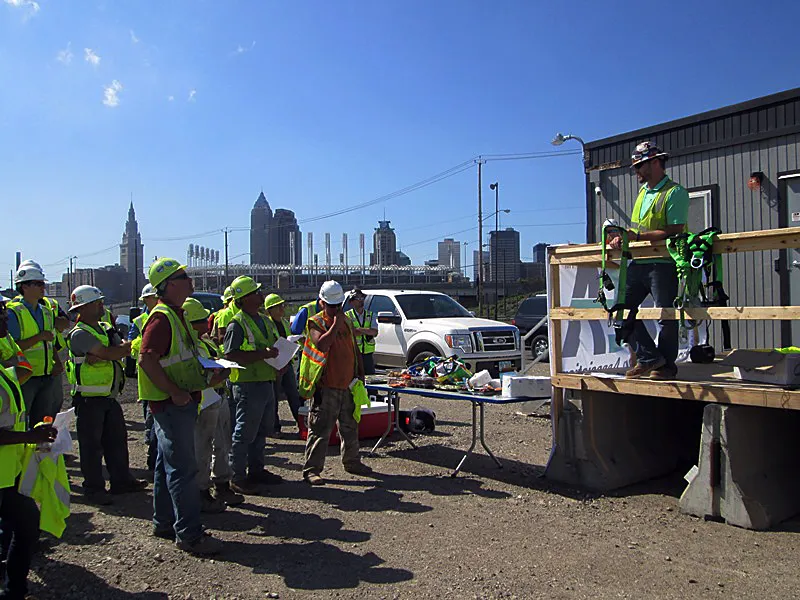
Photo: US Department of Labor, Public domain, via Wikimedia Commons
Every contractor arriving on a UK commercial site in 2026 will hold, or claim to hold, an asbestos awareness certificate. It will be dated within the last twelve months, it will carry a training provider's logo, and it will tell you almost nothing about the building the holder is about to work in. That is not a criticism of the course. It is a criticism of treating the certificate as the end of the conversation rather than the beginning of it.
What the certificate actually establishes
Awareness training covers the essentials well: what asbestos is, where it was used, why the fibres are dangerous, and the broad shape of the legal framework under the Control of Asbestos Regulations 2012. It is a baseline, and the industry is better for it.
What it cannot do is tell a plumber that the riser on the third floor contains a residue of lagging behind a boarded access panel, or that the ceiling tiles in the west corridor were sampled in 2019 and the ones in the east corridor were not. Those facts live in the register. They are building-specific, they change, and they are the facts that determine whether a worker stops or carries on.
The gap that opens on a live site
On a genuinely live site, the generic message collides with commercial pressure. The contractor has a programme, a price and a supervisor expecting progress. The register is in a folder in a facilities office. The permit-to-work mentions asbestos only in a tick box. Under those conditions, 'if in doubt, stop' becomes an aspiration rather than an instruction, because nobody has defined what doubt looks like in this building.
That is the failure mode worth designing against. It is not solved by running the same online module again. It is solved by a short briefing delivered on site, before work starts, by someone who knows the building.
A briefing model that takes twelve minutes
A site-specific briefing does not need to be long. It needs to be specific. Four steps are usually enough.
Step one: anchor to the register
Show the relevant extract, not the whole document. Highlight the entries that fall within the work area and one metre beyond it. Name the materials identified and, just as importantly, name the ones marked 'presumed'. Explain in plain terms what a presumption means for the person holding the tool.
Step two: identify the hot spots
Point to the physical locations. The boiler room ceiling, the service riser, the floor tiles beneath the screed, the gasket on that particular plant item. A briefing that stays abstract will not survive contact with a drill. Where the register allows, walk the route.
Step three: connect to permit controls
Awareness training rarely covers the site's own systems. The briefing should. State who issues the permit, what the asbestos declaration on it requires, what must be photographed and returned, and who authorises a variation if the scope changes mid-job.
Step four: agree stop-work triggers
This is the part most inductions omit. Give the crew a short, unambiguous list of conditions that require work to cease and the supervisor to be called: unexpected fibrous material, damage to a known asbestos-containing product, dust or debris in a location not covered by the register, or any deviation from the surveyed scope. Confirm that stopping work carries no penalty. Mean it.
Delivery discipline matters as much as content
Three practical points determine whether this works.
- Deliver it face to face. A slide pack emailed to a supervisor is not a briefing.
- Deliver it in the work area. Proximity to the actual riser does more than any diagram.
- Keep the group small. Six to ten people is workable; a site-wide gathering is not.
Allow questions, and expect one useful question about a material nobody has yet considered. That question is the return on the twelve minutes.
Record it properly
A briefing that is not recorded cannot be evidenced. Note the date, the names and employer of those present, the register version referenced, the areas covered and the stop-work triggers communicated. Keep the record with the induction pack and the asbestos management plan. Where a material is subsequently discovered, that record demonstrates that the contractor was properly informed — a point of considerable value to both the dutyholder and the contractor.
Repeat it, do not assume it
A briefing has a shelf life. Re-deliver it at each new phase of work, whenever the register is updated, and whenever a new trade arrives on site. The register is a living document and the briefing must track it.
The argument in one sentence
Asbestos awareness training tells a contractor that asbestos is dangerous; a site-specific briefing tells them where it is in this building and what to do when they meet it. Dutyholders who provide only the first have discharged a training requirement and left the real risk untouched.